Historic Downtown Bakersfield Walking Tour · Stop 2
The Historic Fox Theater
A 1930 movie palace and downtown Bakersfield landmark
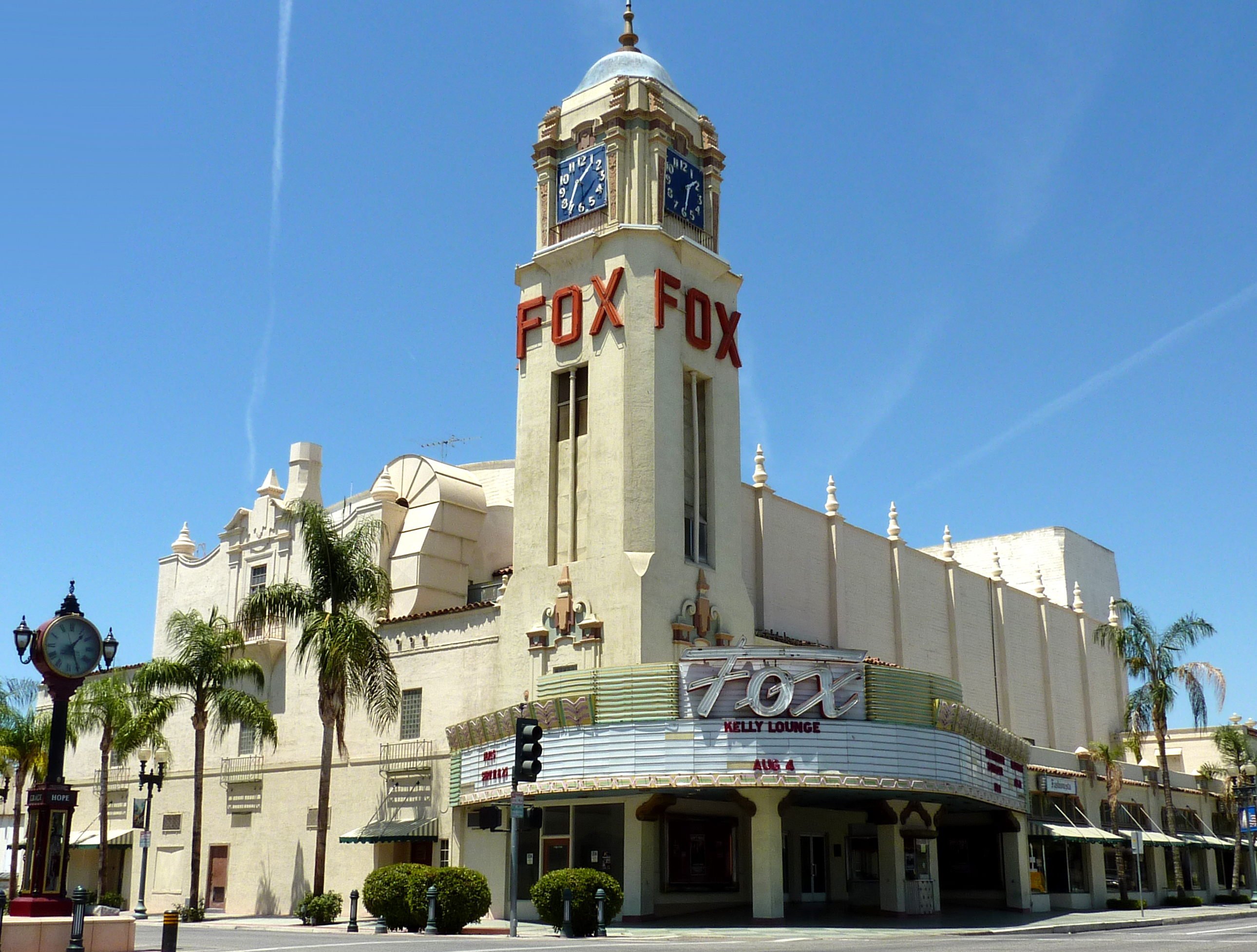
Photo by
Bobak Ha’Eri via Wikimedia Commons,
.jpg)
licensed under
CC BY 3.0.
Quick Facts
- Tour Stop
- Stop 2 of the Historic Downtown Bakersfield Walking Tour
- Landmark
- The Historic Fox Theater
- Address
2001 H Street, Bakersfield, California 93301
- Box Office Phone
- (661) 324-1369
- Official Website
- The Historic Fox Theater
- Ticket Window
1700 20th Street, Bakersfield, California 93301
- Opened
- Christmas Day, December 25, 1930
- First Film Shown
- Just Imagine
- Architect
- S. Charles Lee
- Original Style
- Spanish Colonial Revival exterior with an atmospheric Mediterranean Village interior
- Major Remodel
- 1953 Skouras-style Art Deco / Art Moderne interior and marquee modernization
- Historic Status
- Listed on the Bakersfield Register of Historic Places
Directions from Stop 1: Bakersfield Escape
From Bakersfield Escape in the Historic Haberfelde Building,
return to the sidewalk on 17th Street.
- Walk west on 17th Street toward H Street.
- Turn right on H Street.
- Continue north on H Street to 20th Street.
- The Historic Fox Theater stands at 2001 H Street, near the corner of H Street and 20th Street.
Approximate walking distance: 0.4 to 0.5 mile.
Estimated walking time: 8 to 10 minutes.
Open walking directions from Bakersfield Escape to The Historic Fox Theater
.
Overview
The Historic Fox Theater is one of downtown Bakersfield’s most recognizable landmarks. With its tall clock tower,
bold red “FOX” lettering, curved marquee, decorative tilework, and theatrical sidewalk presence, the building was
designed to make the show begin before a visitor ever entered the lobby.
The theater opened on Christmas Day in 1930, during the early sound-film era, and quickly became a major entertainment
destination for Bakersfield. It was built as a movie palace, but it also included stage facilities that allowed the
venue to host live performances. Over the decades, the Fox has welcomed films, concerts, community events, dance
recitals, comedy shows, graduations, and civic gatherings.
For walking-tour visitors, the Fox is especially important because it shows how downtown Bakersfield presented itself
during the late 1920s and early 1930s: ambitious, urban, stylish, and connected to the national culture of Hollywood
and movie-palace architecture.
What You Will See When You Arrive
The first thing most visitors notice is the clock tower. It rises above the corner and can be seen from several
approaches downtown. Look for the large clock faces near the top of the tower, the red “FOX” letters mounted below
them, and the small dome and finial that finish the vertical composition.
At street level, the marquee creates a dramatic entrance. The curved form wraps the corner and visually pulls people
toward the box office and doors. Look down as well as up: the sidewalk and entry area include polished terrazzo,
a material strongly associated with mid-century theater design and showmanship.
From the sidewalk, notice these details:
- The tall clock tower, which acts as the building’s visual landmark.
- The large red “FOX” letters mounted high on the tower.
- The curved marquee and neon-style theater signage.
- The decorative patterns along the marquee band.
- The Spanish Colonial Revival massing, stucco surfaces, and mission-style roof details.
- The difference between the 1930 exterior architecture and the later 1950s marquee treatment.
- The building’s corner placement, which lets it command both H Street and 20th Street.
The interior is not normally visible to walkers unless the theater is open for an event, but the exterior alone
gives visitors a strong sense of the building’s original purpose: this was architecture meant to attract attention,
build anticipation, and turn an ordinary evening downtown into an event.
Historic Background
The Fox opened on December 25, 1930, at a time when movie palaces were among the most glamorous public buildings in
American cities. Its first feature was Just Imagine, a science-fiction musical comedy that imagined life in
the year 1980. For Bakersfield audiences, the Fox offered more than a screen; it offered spectacle, comfort, fantasy,
and a direct connection to the national movie culture of the early sound era.
The building was designed by S. Charles Lee, a Los Angeles architect who became one of the most important theater
designers in California. Lee understood that a successful theater had to advertise itself from the street. The Fox’s
tower, marquee, neon, and corner presence all support the idea often associated with his theater work: the show begins
on the sidewalk.
The theater was originally designed with a Spanish Colonial Revival exterior and an atmospheric Mediterranean Village
interior. Atmospheric theaters were meant to make audiences feel as if they had stepped into an outdoor courtyard or
romantic foreign setting. Inside the Fox, the original auditorium used a Mediterranean village theme, decorative walls,
and a ceiling intended to suggest an evening sky.
In 1952, the Kern County earthquake sequence damaged many buildings in the region and changed the physical character
of downtown Bakersfield. The Fox survived in large part because of its strong Type I construction, using poured
concrete over steel. Its survival makes it an important downtown comparison point: many older buildings were lost,
but the Fox remained.
In 1953, the theater was remodeled. The original Mediterranean Village interior was replaced with a Skouras-style
Art Deco / Art Moderne design associated with Fox West Coast Theatres and Charles P. Skouras. The marquee, box office,
concession area, and entrance experience were modernized with a more mid-century theatrical character. The result is
one of the most interesting things about the Fox today: it is both a 1930 movie palace and a rare surviving example
of 1950s theater modernization.
The Fox closed in the late twentieth century and was threatened with demolition before the community rallied to save it.
The Fox Theater Foundation was formed in 1994, and the
Save the Fox effort brought the building back from the edge of loss. Restoration began in the 1990s, and the theater
again became a major cultural landmark in downtown Bakersfield.
Construction Date
Construction took place in 1929–1930, and the Fox opened to the public on Christmas Day, December 25, 1930.
- Building: The Historic Fox Theater
- Construction period: 1929–1930
- Opening date: December 25, 1930
- Original use: Movie theater with stage facilities for live presentations
- Architect: S. Charles Lee
- Local supervising architect: Charles H. Biggar
- Builder: Beller Construction
- Original seating capacity: Approximately 1,500 seats
- Major remodel: 1953
- Community rescue and restoration: Beginning in 1994
- Current use: Historic landmark, performing arts venue, and community event space
Architectural Style
The Fox is best understood as a layered building. Its exterior belongs primarily to the Spanish Colonial Revival
tradition, while its current interior and marquee reflect the 1953 Skouras-style Art Deco / Art Moderne remodeling.
That combination gives the theater much of its character.
Spanish Colonial Revival Exterior
The original exterior uses stucco surfaces, mission-style roof elements, decorative tower details, and a strong
corner massing. The clock tower gives the building a civic presence, while the marquee makes it unmistakably theatrical.
Unlike a simple storefront theater, the Fox was designed to be seen from a distance.
Atmospheric Mediterranean Village Interior
When the theater opened, its auditorium followed the atmospheric-theater tradition. Rather than simply decorating a
room, atmospheric theaters attempted to transport audiences into a fantasy setting. The Fox’s original interior
suggested a Mediterranean village or courtyard beneath a theatrical night sky.
1953 Skouras-Style Modernization
The 1953 remodel gave the auditorium and public areas a more modern postwar identity. The style combined Art Deco,
Art Moderne, Streamline Moderne, gilded ornament, drapery forms, and showy mid-century theatrical design. The
exterior marquee and box office were also updated, creating much of the sidewalk experience visitors see today.
Connection to Stop 1: From Office Tower to Movie Palace
Stop 1, the Historic Haberfelde Building, and Stop 2, the Historic Fox Theater, are two of the strongest surviving
statements of downtown Bakersfield’s late-1920s and early-1930s confidence.
The Haberfelde Building, completed in 1927, represents downtown business life: offices, commerce, professional tenants,
and the vertical ambition of a growing regional center. The Fox, opened in 1930, represents downtown entertainment:
movies, live performance, glamour, neon, and the public ritual of going out for the evening.
Both buildings use height as part of their identity. The Haberfelde Building rises as a commercial office building.
The Fox rises through its clock tower and signage. Together, they show that downtown Bakersfield was not built only
for practical business; it was also built for display, memory, and civic pride.
Interesting Stories and Local Memory
A Christmas Day Opening
The Fox opened on Christmas Day in 1930. That date gave the new theater an instant sense of occasion. For early
audiences, a Christmas opening at a glamorous movie palace would have felt like a civic celebration as much as a
movie screening.
A Film About the Future
The first movie shown at the Fox was Just Imagine, a futuristic story set in 1980. Today, that detail gives
the theater a charming historical irony: a 1930 audience sat in one of Bakersfield’s most modern buildings watching
Hollywood imagine what the future might look like.
The Theater That Survived
The Fox’s survival through the 1952 earthquake sequence is one of the major reasons it remains so important to downtown.
Many historic buildings in Bakersfield were damaged, demolished, or substantially altered. The Fox endured and later
became a symbol of preservation.
Saved from the Wrecking Ball
By the 1990s, the Fox was in danger. The community-led Save the Fox effort, organized through the
Fox Theater Foundation, helped preserve the building
and return it to public life. That story is a major example of Bakersfield historic preservation succeeding through
local commitment.
Memories on H Street
The Fox is more than an architectural object. It is a memory bank for generations of Bakersfield residents who came
here for movies, concerts, school events, performances, and downtown nights out. The theater’s
Memories on H project preserves some of that community
memory and reinforces why the building matters beyond its bricks, neon, and plasterwork.
Visitor Information
Walking-tour visitors can view the exterior from the public sidewalk at H Street and 20th Street. The best exterior
views are from across H Street, from the 20th Street corner, and from the sidewalk directly beneath the marquee.
- Main theater address:
2001 H Street, Bakersfield, California 93301
- Ticket window:
1700 20th Street, Bakersfield, California 93301
- Box office phone:
(661) 324-1369 - Official information:
The Historic Fox Theater contact page - Interior access:
Usually available when attending a public event or performance.
Even when the theater is closed, this is one of the best exterior stops on the tour. The clock tower, marquee,
terrazzo, signage, and corner composition can all be appreciated from the sidewalk.
Historic Photographs
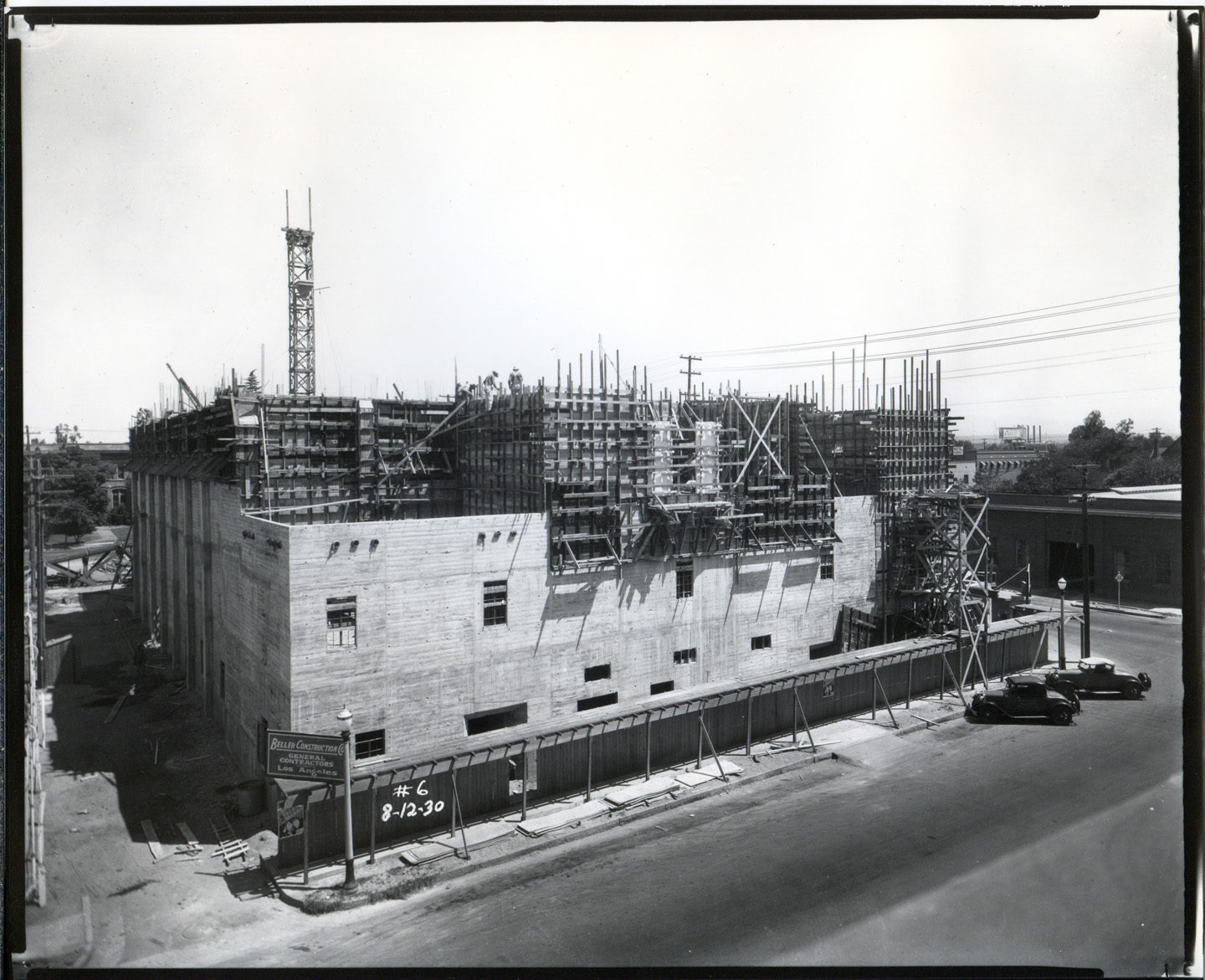
Image from
The Historic Fox Theater history page.

Image from
The Historic Fox Theater history page.

Image from
The Historic Fox Theater history page.
These historic images help visitors imagine the Fox as early audiences experienced it: a new downtown movie palace
built for spectacle, visibility, and civic excitement.
Modern Photographs
Photo by
Bobak Ha’Eri via Wikimedia Commons,
licensed under
CC BY 3.0.

Photo by
Carol M. Highsmith, Library of Congress, via Wikimedia Commons.
No known restrictions on publication.

Photo by
Joseph Vasquez via Wikimedia Commons,
.jpg)
licensed under
CC BY 2.0.
What to Notice Before You Walk On
Before leaving the Fox, pause and study the building as if it were a theater poster made out of architecture.
Look for these five details:
- The clock tower: It makes the building visible from blocks away and gives the theater a civic
landmark quality. - The red “FOX” letters: They are simple, bold, and legible from the street, making the building
advertise itself. - The curved marquee: It wraps the corner and creates a dramatic transition from public sidewalk
to theater entrance. - The terrazzo entry area: This sidewalk-level detail is part of the theater’s mid-century showmanship.
- The architectural layering: The Fox is not just a 1930 building; it also carries the story of its
1953 modernization and 1990s preservation.
Directions to Stop 3: The Padre Hotel
From the Fox Theater entrance, continue to the next landmark: The Padre Hotel.
- Stand facing H Street at the Fox Theater.
- Walk south on H Street toward 18th Street.
- Continue for two blocks.
- The Padre Hotel is located at 1702 18th Street, at the corner of 18th Street and H Street.
Approximate walking distance: 0.2 mile.
Estimated walking time: 4 to 5 minutes.
Open walking directions from The Historic Fox Theater to The Padre Hotel
.
Photo Credits
- Historic Fox Theater images:
The Historic Fox Theater history page. - Modern exterior hero image:
Bobak Ha’Eri via Wikimedia Commons,
CC BY 3.0. - 2012 clock tower and marquee image:
Carol M. Highsmith, Library of Congress, via Wikimedia Commons,
no known restrictions on publication. - Street-level tower image:
Joseph Vasquez via Wikimedia Commons,
CC BY 2.0.